Ledger implant attack: am I affected?
Ledger implant attack: what happened, whether purchases at MediaMarkt are affected, why the Genuine Check is not enough and what to do now.
In this guide
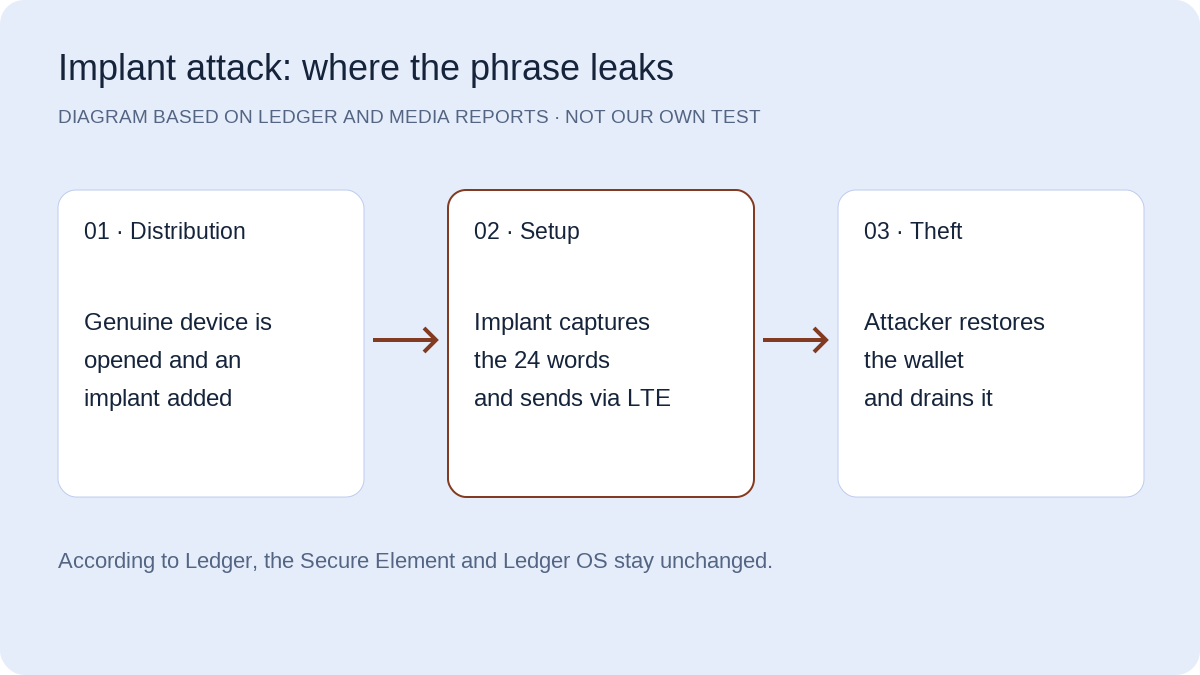
In October 2026 it became known that criminals had opened genuine Ledger devices and fitted them with a hidden radio module. During setup, the implant captured the recovery phrase and sent it on over the mobile network. Ledger confirmed the implant in devices from the Malaysian reseller CryptoBilis; the estimated losses also relate to these purchases. If you bought your device directly from Ledger and set it up yourself, there is currently no indication that you are affected.
MediaMarkt and Saturn removed Ledger devices from sale as a precaution on 13 October after a buyer in Germany reported an implant. According to Ledger, no loss of funds was reported in that case, and no device examined in test purchases from stores, including in Germany, had been tampered with.
This guide summarises Ledger's statement and media reports, retrieved on 8 November 2026. We have not opened or examined any devices ourselves. The investigation is ongoing; details may change.
Attack
Implant captures the phrase, sends it via LTE.
Confirmed
In devices from the reseller CryptoBilis.
Check
Purchase route matters, the genuineness check (Genuine Check) is not enough.
What happened in the Ledger implant attack?
According to Ledger, an organised group spent many months buying genuine Ledger devices, opening them and fitting its own hidden components. The devices went back on sale through resellers in Southeast Asia. Later, the group drained the buyers' wallets in a coordinated operation. Ledger calls this an attack on the distribution channel after the devices had left the company, and writes that its chip, operating system and servers had no flaw.
| Date | Event | Source |
|---|---|---|
| 2026-10-09 | Ledger investigates loss reports and asks CryptoBilis to stop selling and shipping | BleepingComputer |
| 2026-10-10 | Ledger confirms tampering with at least one device | Decrypt, BleepingComputer |
| 2026-10-13 | MediaMarktSaturn removes Ledger devices from stores and online shops as a precaution | The Block, Cointelegraph |
| 2026-10-15 | Ledger publishes its statement; resellers in Southeast Asia and Hong Kong are to suspend sales | Ledger blog |
Ledger says it is working with law enforcement and announces further technical details. The statement does not mention compensation for those affected. Ledger has not disclosed which models are affected; according to BleepingComputer, the implant was found in a Nano X.
Am I affected?
You cannot reliably spot an implant from the outside. The key question is therefore where your device came from and who generated the recovery phrase.
- CryptoBilisReseller where Ledger confirmed the implant
- over USD 86 millionEstimate by an on-chain investigator, not confirmed by Ledger
- 2026-10-13MediaMarktSaturn stops sales as a precaution
| Purchase route | Status according to sources | What you do |
|---|---|---|
| CryptoBilis (Malaysia, sales in Southeast Asia) | Ledger confirmed the implant here; the estimated losses relate to these purchases | Treat the device as compromised and move as described below |
| Other resellers in Southeast Asia and Hong Kong | Sales suspended at Ledger's request; Ledger is checking individual reports, link not confirmed | If in doubt, move |
| Marketplaces such as Amazon Japan or Yahoo! Auctions Japan | Researchers analysed tampered devices offered there, according to BleepingComputer at almost half price | Treat the device as compromised |
| MediaMarkt / Saturn | Removed from sale in all countries as a precaution on 13 October 2026 after a buyer in Germany reported an implant; according to Ledger no loss of funds in that case. We have not checked whether sales have resumed | Check packaging and receipt; if unsure, move |
| Authorised reseller | According to Ledger, test purchases from stores, including in Germany, were clean | No reason to switch if the packaging was undamaged and you generated the phrase yourself |
| Directly from ledger.com | No indication of affected devices | No reason to switch |
| Second-hand or unsolicited replacement | Purchase route cannot be traced | Treat the device as compromised |
Two warning signs apply regardless of the purchase route: opened or damaged packaging, and an enclosed, already filled-in word list or PIN. Genuine devices come without either; in that case, do not use the device and contact Ledger Support. Weight or battery, on the other hand, are not a reliable test: one known variant has a smaller replacement battery, another uses the original battery.
According to Ledger, its teams bought devices from stores, including in Germany, and opened them. Many samples from its own stock were also checked. No device examined had been tampered with. According to Decrypt, the on-chain investigator Specter estimates the suspected thefts at over 86 million US dollars; Ledger has confirmed neither the total nor the number of people affected.
What should you do if your device could be affected?
According to BleepingComputer, Ledger advises: anyone who bought from the affected reseller and has not set the device up yet should not start setup. Anyone who has already set it up should consider moving their holdings to a new Ledger device with a new recovery phrase.
- Buy a new device directly from the manufacturer and set it up yourself. The new recovery phrase must be generated on the new device.
- Never enter the old phrase into the new device. Treat it as possibly known; restoring it would carry the problem over.
- First send a small amount to an address of the new wallet and check that it arrives. Then move the rest.
- Also move tokens, NFTs and staking positions on all networks you use. Review permissions you granted apps or smart contracts for your old account.
- If you lost funds, file a police report, keep the transaction IDs and inform Ledger Support. Do not open the device yourself: according to The Block, Ledger advises coordinating with the police first so that evidence is preserved.
If you also entered a passphrase on the device, treat it as known too, because the implant captures the display and inputs. Set up a new phrase and, if needed, a new passphrase on the new device.
How did the implant work?
According to reports on analyses by Ledger's security team Donjon and independent researchers, an additional small chip with its own SIM card and mobile module (LTE) sits inside the enclosure. It captures the display and button presses while the device shows the 24 words during setup, and sends them over the mobile network. According to BleepingComputer, two hardware variants were found, one of them with a smaller replacement battery.
According to Decrypt, Ledger writes that the implant modifies neither the Secure Element nor the operating system. That is what makes the attack dangerous: the device behaves normally and passes the genuineness check. The attacker does not need the device at all; the recovery phrase is enough.
Why the Genuine Check does not detect this
The Genuine Check in Ledger Wallet uses a signature to verify that the Secure Element is genuine. Ledger's own threat model states explicitly that the check does not detect unauthorised physical changes to the hardware, such as spy implants, as long as the original Secure Element is fitted. Nor can it prove the device's path through the supply chain. A passed check is therefore necessary, but not proof of an unaltered device.
How do you protect yourself on your next purchase?
This case does not only affect Ledger customers. According to The Block, Trezor removed CryptoBilis from its reseller list as a precaution. OneKey revoked the reseller's authorisation and offers free replacements for OneKey devices bought through CryptoBilis between 1 March and 13 October 2026. Every hardware wallet is only as trustworthy as its route to you. These rules lower the risk:
- Buy directly from the manufacturer or an authorised reseller. On marketplaces, check who is actually selling.
- Avoid suspiciously cheap offers. According to BleepingComputer, tampered devices were offered at almost half price.
- Do not buy second-hand devices and do not accept replacement devices you did not order.
- Always generate the recovery phrase yourself on the device and write it only on paper or metal.
- Spread larger holdings across several wallets or use a multi-signature setup (multisig), where several devices must approve a transfer.
Ledger has tightened its reseller rules: devices should no longer be on open shelves, and returned units must not be resold. Ledger sells the new Ledger Atom exclusively itself and describes more tamper protection in the enclosure.
Who checked this?
Frequently asked questions about the Ledger implant attack
Was Ledger itself hacked?
Not according to Ledger: the company speaks of an attack on distribution, not on its own systems. What has been independently confirmed so far is the implant itself, through analyses by external researchers, not Ledger's statement about its own systems. The investigation is ongoing.
Is my Ledger from MediaMarkt affected?
Not demonstrably. MediaMarktSaturn stopped sales as a precaution on 13 October 2026 after a buyer in Germany reported an implant. According to Ledger, no loss of funds was reported in that case. According to Ledger, all devices examined in test purchases from stores, including in Germany, were clean. If you are unsure, move to a device bought directly with a new phrase.
Is the Genuine Check enough?
No. The Genuine Check only confirms that the Secure Element is genuine. According to Ledger, it does not detect an additional implant next to the original chip. What matters is the purchase route and a recovery phrase you generated yourself.
Can I keep using my old recovery phrase?
If you bought directly from Ledger or an authorised reseller, received undamaged packaging and generated the phrase yourself on the device, there is currently no reason to switch. If you bought via CryptoBilis, a marketplace or second-hand, treat the phrase as known. Then the only fix is a new phrase on a new device and moving all holdings.
How large is the damage?
That is open. According to Decrypt, the on-chain investigator Specter estimates the suspected thefts from CryptoBilis purchases at over 86 million US dollars. Ledger has confirmed neither the total nor the number of people affected.
Has JMRKT examined affected devices itself?
No. This guide summarises Ledger's statement and reports from specialist media, retrieved on 8 November 2026. We have not opened or tested any devices and will update the text when Ledger publishes further details.