DAC8 from 2026: what crypto exchanges report to tax authorities
Which crypto data is collected from 2026, when providers report it in 2027 and how to organise your records before year-end.
In this guide
Your crypto exchange asks for your tax residence and tax ID. Meanwhile, you read that crypto data is not reported until 2027. Both can be consistent: 2026 is the first reporting year; the data is submitted in 2027. Waiting until then to find your documents may require reconstructing an entire trading year retrospectively.
This guide explains the reporting framework for private users with a connection to Germany, highlights key distinctions and helps organise your records. Legal provisions and sources were checked on 6 October 2026. It does not calculate individual tax liabilities or determine the treatment of a specific transaction.
Data collection
Reportable transactions from 2026.
Submission
The first submission follows in 2027.
Your records
Keep traceable records of purchases, fees and transfers.
What is DAC8 and what changes for you?
DAC8 extends cooperation between EU tax authorities to crypto-assets. Reporting service providers collect information about users and relevant transactions. Data goes to the competent tax authority and is exchanged between countries through the prescribed process. Germany implements these rules through the Crypto-Asset Tax Transparency Act, known as KStTG. European Commission: framework and application date.
In everyday use, a provider may request additional tax information, update notices about data exchange and systematically record reportable activities. These rules concern data submission. Being reported does not itself reveal your individual tax liability or prove that your records are complete.
When choosing a platform, you can still use the Crypto exchange comparison. Available export formats address a different question: how can you obtain your data? That is covered in German tax reports: native reports, CSV and API exports.
2026 or 2027: which dates apply to which obligations?
The distinction between years matters. Reportable transactions from 2026 are submitted in the following year. For providers reporting to Germany's Federal Central Tax Office under KStTG, Section 9 KStTG sets 31 July of the following year as the statutory reporting date. The first EU data exchange for 2026 is scheduled by 30 September 2027. Other countries may have different national deadlines.
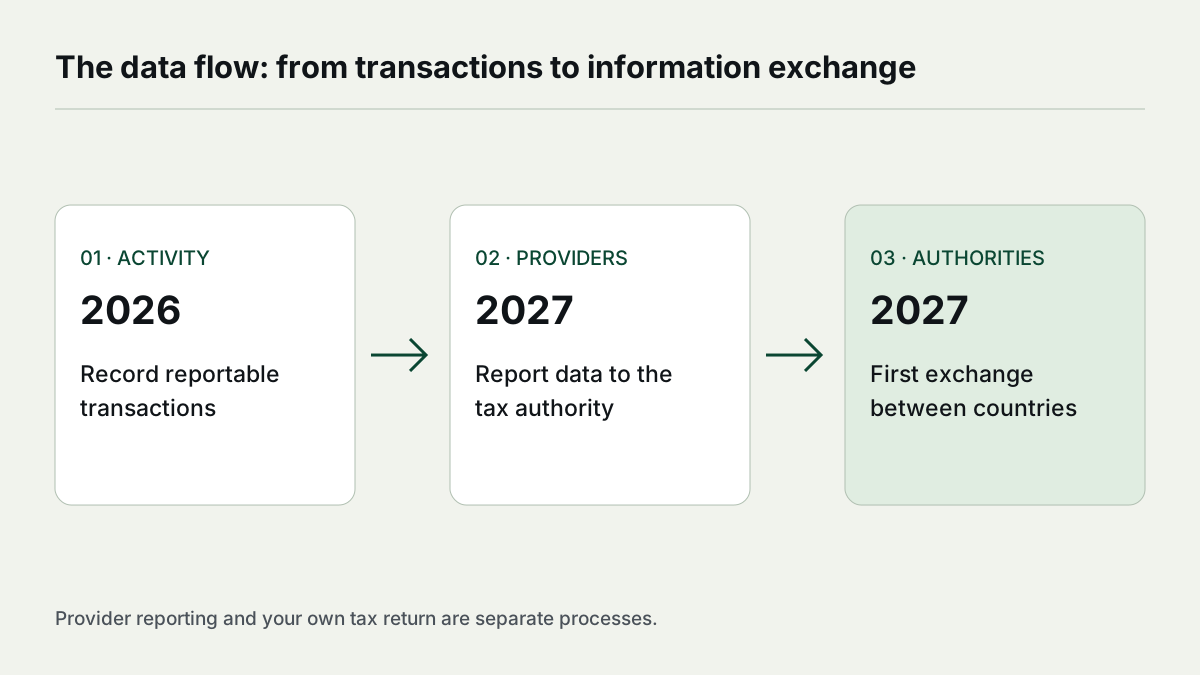
Check your tax-return deadline separately. A platform's request for a tax self-certification may have its own deadline. Waiting until 2027 to prepare everything confuses the provider's submission date with the year in which the transactions occurred.
For customer relationships already established by the end of 2025, providers generally have until 1 January 2027 to complete the prescribed due-diligence procedures. This helps explain why existing customers may receive new questions during 2026. Section 7 KStTG.
Why does the exchange ask for your tax ID?
A valid tax self-certification for an individual includes their name, address, tax-residence countries, associated tax identification numbers and date of birth. The number may have a different name or functional equivalent in another country. Your actual tax residence is what matters. Section 6 KStTG.
Verify the request in the official app or by opening the provider's website yourself. If you moved, have multiple tax-residence countries or see conflicting information, clarify the details before confirming a form. A tax ID is personal data; handle it carefully.
Ignoring the request is not a reliable solution. The law provides for reminders and formal notices. For certain existing customers who continue withholding the requested information, the provider must eventually prevent reportable transactions. The precise conditions are in Section 8 KStTG. This does not mean that every missed app notification immediately causes an account restriction.
Which data is reported?
The report combines identification data with information about each reportable crypto-asset. Much of the transaction data is aggregated, meaning combined into totals. Section 11 KStTG distinguishes, among other things:
| Category | Required information, simplified |
|---|---|
| Purchases using euros or other fiat currencies | Total gross amount, units and number of transactions |
| Sales for fiat currencies | Total gross proceeds, units and number of transactions |
| Exchanges between reportable crypto-assets | Market values, units and number of transactions |
| Certain transfers | Market values, units and further details depending on the category |
For individuals, the statutory identification data is also included. The law additionally covers certain transfers to addresses whose association with a service provider is unknown to the reporting provider. Withdrawing to your own wallet therefore does not automatically remove that transaction from the reporting framework.
The table offers an overview of selected categories. Whether a specific provider or transaction is covered depends on the statutory definitions and applicable jurisdiction. Claiming that every blockchain movement is automatically reported in full would go too far.
Provider reporting, tax reports and tax returns serve different purposes
Consider a fictional example: you buy EUR 1.000 of Bitcoin, transfer part between your own accounts and later sell for EUR 600. Those figures alone do not establish the purchase costs associated with the sold units, the fees or holdings that already existed before 2026.
A total sales amount is therefore not a finished calculation of personal profit. A working table needs the individual transactions and how they connect. A provider report can help, but its usefulness depends on the data it covers and its assumptions.
The BMF's letter of 6 March 2025 explains cooperation and record-keeping obligations and the role of tax reports. Establishing your own facts remains important, especially when several platforms are involved. BMF on crypto-assets and documentation.
A useful practical approach is to maintain three folders: unchanged raw data, your own mapping and calculations, provider notices and reports. This helps distinguish original export data from your own additions later.
Your year-end checklist for 2026
Start with a complete list of your accounts and wallets. Small remaining balances, rarely used exchanges and closed accounts are easily overlooked. Export the histories with a clearly documented date range. A November export can secure the data available so far; a complete calendar-year record also needs the subsequent December transactions.
This checklist is an editorial organisation aid. It is not a statutory form and does not certify that a tax return is complete.
Take organised records into 2027
Ticks apply to this page view and are not saved. Download the checklist for your own records.
For transfers between your own accounts, make a short record of the sending account, receiving account, asset, network, time and transaction ID where available. Store it alongside the relevant export. This helps prevent a withdrawal from later appearing as a missing purchase or an incoming transfer as an unexplained new holding.
Clearly mark missing values. An unknown fee remains unknown until you can substantiate it. Turning an empty cell into zero creates only apparent completeness. Keep working copies and original files in a way that makes changes traceable.
What if data is incorrect or inconsistent?
First identify the type of error: personal information, missing export, duplicated import or provider data that conflicts with your records. Note the date, platform and specific discrepancy. Use the provider's official contact method to address incorrect data and keep the response.
Under Section 9 KStTG providers must correct reporting errors they discover. Section 13 KStTG also requires providers to inform affected users before the first submission. A support response does not replace checking your own tax return.
If the tax treatment is unclear, bring complete raw data, your transaction mapping and a short list of open questions to a qualified tax adviser. This lets the review start with the facts rather than reconstructing a year from account balances.
Frequently asked questions about DAC8 and crypto
Are only transactions from 2027 reported?
Is the DAC8 report also my tax return?
Is my own hardware wallet automatically excluded?
Is 31 July my personal tax-return deadline?
Do I need to give my recovery phrase for tax self-certification?
Further reading: Understand export formats, Payout to your own wallet and Compare exchanges using documented criteria.
This article provides general information and an organisation aid. It does not replace individual tax or legal advice.