Is crypto cashback worthwhile? Calculator and examples
Calculate what remains of crypto cashback after subscriptions, exclusions, caps and conversion fees. Includes three everyday scenarios.
In this guide
Two percent cashback on EUR 1.000 of card spending is EUR 20 mathematically. That is only the start. If only part of your spending qualifies, a cap applies and fees are added, the remaining benefit may be much smaller or negative.
A crypto cashback card makes financial sense in the model when the usable reward value exceeds your additional costs. Whether the card also fits your practical needs depends on custody, payment processes, tied-up capital and the type of reward. This guide combines a transparent euro calculation with the questions that remain outside it.
Spending
Only eligible payments earn cashback.
Costs
Consider fixed costs and payment fees together.
Result
Euro model before tax and token-price changes.
Crypto cashback calculator: your benefit after fees
Enter the terms for your specific card tier and region . Use the ongoing cashback rate rather than an unchecked introductory bonus. If a provider states a cap in dollars or tokens, this euro model needs a substantiated euro value. An unknown cap is not confirmed unlimited rewards.
Your calculation · processed locally in your browser
What remains after fees?
Starting values are a fictional example. Enter the terms of your specific card tier. No bank or wallet connection is required.
The model applies the conversion fee to all spending. The foreign-currency markup applies only to the specified foreign-currency share. Add other fixed costs to the monthly fee if needed.
- Cashback before fees
- EUR 16.00
- Monthly subscription and allocated annual fee
- EUR 5.00
- Conversion / top-up
- EUR 5.00
- Foreign currency
- EUR 1.00
Costs are covered from EUR 500,00 in monthly spending, up to EUR 2.500,00 under these assumptions. The cap and variable fees limit the benefit.
The cashback cap has not been reached yet.
Assumes a constant euro reward value and unchanged terms over twelve months. Taxes, token-price changes, tied-up capital, interest, ATM fees and special perks are excluded. This calculator neither stores nor transmits your inputs.
The starting values do not describe a real card offer. They make the model verifiable: EUR 1.000 monthly spending, 80% eligible, 2% cashback, a EUR 20 monthly reward cap, EUR 5 monthly fee, 0.5% conversion on all spending, and a 1% foreign-currency markup on 10% of spending.
The calculator runs locally and does not require a login or connected accounts. Each fee you enter is an assumption that you should verify against the current price list and your actual payment method.
The formula: which amounts are included?
Start with eligible spending. If 80% of EUR 1.000 qualifies, the reward base is EUR 800. A 2% rate initially produces EUR 16. Then check whether a cashback cap limits that amount.
| Calculation step | Formula used in the euro model |
|---|---|
| Eligible spending | Monthly spending × eligible share |
| Reward | Lower of eligible spending × cashback rate and the reward cap |
| Monthly fixed costs | Monthly fee + additional annual fee ÷ 12 |
| Conversion / top-up | Total monthly spending × effective fee rate |
| Foreign currency | Monthly spending × foreign-currency share × markup |
| Recurring benefit | Reward − fixed costs − conversion − foreign-currency costs |
| First year | Recurring monthly benefit × 12 − one-off costs |
For multiplication, convert percentages into proportions: 2% becomes 0,02. Enter an annual subscription only in the annual field if you have not already included its monthly share. Both fixed-cost fields are added together, preventing accidental double counting when used correctly.
Conversion costs are deliberately modelled as an effective rate on total card spending. If only part of your spending is funded through a fee-charging method, enter the appropriate weighted rate. For a simplified calculation, add ATM charges or other regular costs to the monthly fee; this then represents your chosen usage mix.
Three everyday scenarios: EUR 300, 1.000 and 2.000
All three examples use the same fictional terms as the calculator. They are not tests of real cards, manufacturer price quotes or recommendations. Annual and one-off costs are zero in these examples.
Monthly spending
EUR 300.00- Eligible (80%)
- EUR 240.00
- Reward after cap
- EUR 4.80
- Monthly fee
- EUR 5.00
- Conversion
- EUR 1.50
- Foreign currency
- EUR 0.30
Monthly spending
EUR 1,000.00- Eligible (80%)
- EUR 800.00
- Reward after cap
- EUR 16.00
- Monthly fee
- EUR 5.00
- Conversion
- EUR 5.00
- Foreign currency
- EUR 1.00
Monthly spending
EUR 2,000.00- Eligible (80%)
- EUR 1,600.00
- Reward after cap
- EUR 20.00
- Monthly fee
- EUR 5.00
- Conversion
- EUR 10.00
- Foreign currency
- EUR 2.00
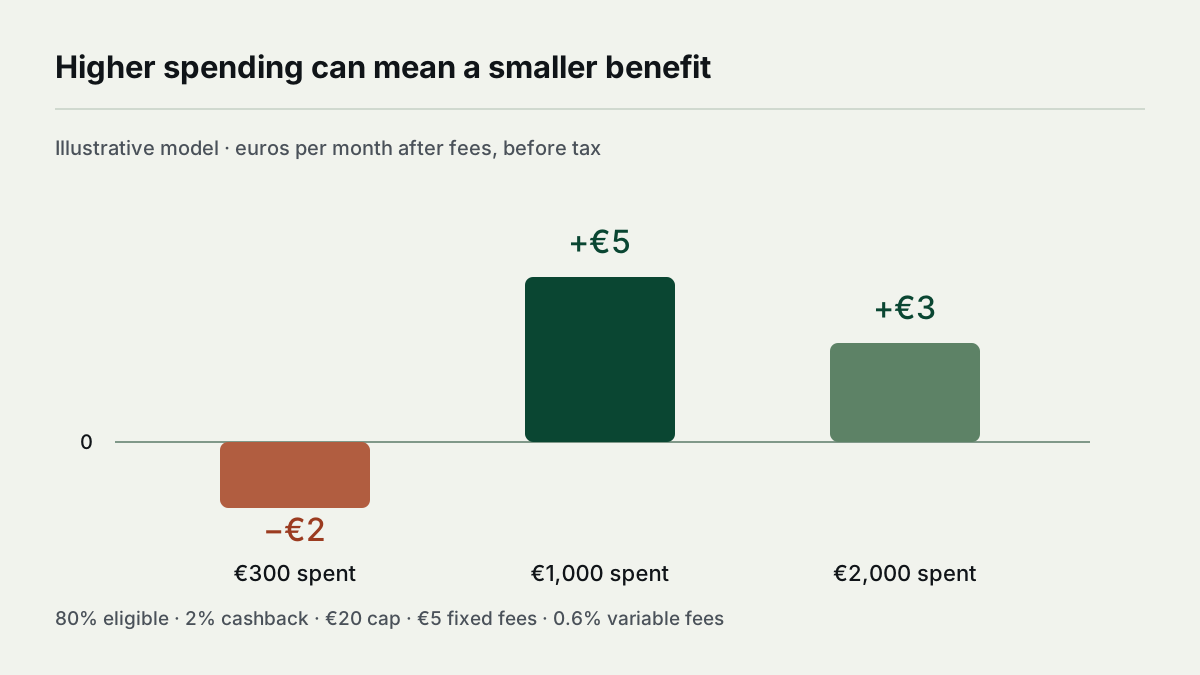
At EUR 300, rewards do not cover all costs. At EUR 1.000, EUR 5 remains. At EUR 2.000, the uncapped reward would be EUR 32, but this model pays at most EUR 20. Variable fees keep increasing, so the benefit falls to EUR 3 despite higher spending.
Over twelve identical months, these examples produce −24, 60 and 36 euros. Changes in your spending mix, terms or token value change the result. The annual figures are projections using constant assumptions.
How much spending covers the costs?
Before the cap applies, this example earns an effective 1,6 cents per euro of total spending: an 80% eligible share multiplied by 2% cashback. Variable fees use 0,6 cents per euro. That leaves 1 cent per euro to cover the EUR 5 monthly fee.
The lower cost-coverage point is therefore EUR 500 in monthly spending. The cap also creates an upper limit in the same model: at EUR 2.500 the EUR 20 reward exactly equals the EUR 5 fixed costs plus EUR 15 variable fees. Beyond that, the benefit becomes negative again. The calculator includes both boundaries when they result from your inputs.
An offer with at most EUR 10 in monthly rewards and more than EUR 10 in unavoidable fixed costs cannot deliver a positive recurring benefit, even before variable fees. A higher percentage does not change that limit. Always assess the rate, cap and costs together.
Do not increase your spending to make use of a cashback rate. Start with payments you would make anyway. The card should fit your life; an additional purchase costs much more than its reward returns.
Which terms change your calculation?
Excluded payments
Not every payment qualifies. Providers may exclude certain merchant categories, money transfers or other transactions. Crypto.com, for example, documents merchant-category restrictions in its CRO rewards program. The actual classification and program terms determine eligibility. Crypto.com: reward exclusions.
Estimate the eligible share using your own payments. If much of your spending does not qualify, calculating with 100% applies the advertising to a usage pattern it does not cover. Refunds and cancelled transactions also belong in the actual reconciliation.
Subscription, token lockup or savings plan
Depending on the tier, Crypto.com lists a subscription or CRO lockup or staking as a way to join Level Up. These options have different costs and risks. Crypto.com: Level Up.
Trade Republic invests Saveback into a selected savings plan. Its German help page also states a monthly savings-plan requirement. That contribution is an investment rather than a card fee, so it should not simply be entered as a lost amount in the fee field. The additional commitment still needs to fit your plans. Trade Republic: Saveback.
Costs along the payment process
Check how the card is funded: euro balances, selling crypto-assets, stablecoin spending or credit secured by collateral. Depending on the process, extra fees, spreads or interest may apply. For a credit model, cashback arithmetic alone is insufficient. The basic fee layers are covered in Crypto cards in everyday life.
Assess token rewards and tied-up capital separately
A reward paid in tokens has a euro value at a particular time. That value may rise or fall before you use or exchange it. Additional sale or transfer costs may also matter. The calculator holds the entered reward value constant; it does not predict token prices.
Buying or locking tokens solely to qualify for a card tier is a separate investment decision. Record the committed amount, lockup duration, possible fees and price risk. A change in that holding's price may greatly exceed a few euros of cashback. Do not create an apparently certain total return by adding a promised token yield without checking it.
Tax questions concerning rewards and the crypto-assets used to fund payments also need separate consideration. The result after fees and before tax is deliberately not a personal after-tax calculation.
Use the result to compare cards
Run two calculations using the same realistic spending mix: one for your current payment method and one for the card tier you are considering. Compare the additional benefit. If your existing card already pays rewards, the entire new reward is not an additional gain.
Record a source date for each assumption and check the region. A US credit-card program, a European prepaid tier and an expiring promotion are different offers. Compare only terms actually available to you.
Then consider the practical questions: who holds custody? Which currency is charged? What limits apply? Does the documented payment method fit your intended use? Use the Crypto card comparison for the features and Custodial vs. non-custodial for custody. A positive calculation does not replace those checks.
Frequently asked questions about crypto cashback
Is a card offering 3% always better than one offering 1%?
What does an empty cashback-cap field mean?
Are the starting values current prices for a particular card?
Are my inputs stored or sent to a provider?
Why are taxes and staking returns excluded?
Can the benefit decrease again at higher spending?
Sources checked on 6 October 2026. The calculation method is transparent; real terms must be checked for current validity. General information, not individual investment or tax advice.