Custodial vs Non-Custodial Crypto Cards Explained
Understand crypto card custody: assess provider accounts, your own wallet, spending permissions and recovery using practical questions.
In this guide
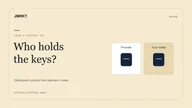
For a crypto card, understand who controls the balance used for payments and how the program accesses it. Custodial means custody by a provider; non-custodial refers to a wallet under your control. The card program may still depend on service providers, smart contracts and granted spending permissions.
Further reading: Card comparison.
This text is a reading aid for the filter custody=custodial|non_custodial and to the shortcut “Suitable for non-custodial”. It does not replace any product page or methodology. He says which question the cell answers - and which one it consciously leaves open.
Non-custodial does not mean safer. Custodial does not mean illegal.
Custodial
Balance on the provider account — counterparty like on an exchange.
Non-custodial
Card on a wallet, not on the exchange account - seed risk for you.
Filters
Hides columns. No ranking.
Check custody: control, access and recovery

The Custody feature distinguishes funds held in a provider account (custodial) from a card linked to your own wallet (non-custodial). The custody filter follows this documented architecture.
The non-custodial filter shows offerings documented accordingly. Then check the specific card tier: which wallet and assets are supported, how does the program receive payment permission and what recovery process is available? The filter selection does not answer these follow-up questions.
Practical: open it Card comparison, add Germany, Austria and Switzerland and Wallet-Pay if necessary, and then read the remaining columns. The pool all ensures that the filter affects every SKU column - not just a preselection. If you only set non-custodial first and then add Germany, Austria and Switzerland, you will see the overlap shrink: that is intentional, not an error in the table.
Two misunderstandings keep cropping up here.
For non-custodial programs, securing and recovering wallet access remain central responsibilities. Depending on the architecture, smart-contract risks and spending permissions also apply. Check how much a service can move and how permission can be changed or revoked. A card limit and wallet permission may be different settings.
Second: Custodial is not a legal judgment. Many everyday programs in Germany, Austria and Switzerland are custodial — debit or prepaid on an account with the issuer or the exchange below. This is an opposing party, not a statement of permission or prohibition. Whether you accept this is a question of fit, not a moral question of the table.
Levels (Core, Luxe, Prepaid Basic, Metal) remain own columns. A four-tier noncustodial program is not “one card.” Caps, costs and saveback are per level - exactly like that Methodology crypto cards it describes for purchaseable levels.
Six provider examples with different custody models

The following six examples use the August 2026 catalog. The recorded regions, tiers and functions have not undergone a new conditions review. Open the relevant product page and check the program currently available for your residence before registering or providing funds.
Non-custodial (wallet)
-
ether.fi Cash — Visa, non-custodial, with recorded coverage in Germany, Austria and Switzerland. Core, Luxe, Pinnacle and VIP have separate columns and limits; the product page covers the overall program. Apple Pay and Google Pay are documented. Check saveback and spending limits for the specific card tier.
-
Gnosis Pay — Visa, non-custodial, Germany, Austria and Switzerland DE/AT/CH, Wallet-Pay yes. The card is attached to your own wallet instead of to the exchange account. This is the classic non-custodial case in the shortcut “Suitable for non-custodial” — without ranking compared to ether.fi or MetaMask.
-
MetaMask Card — Mastercard, non-custodial, Germany, Austria and Switzerland DE/AT/CH documented. Virtual and Metal are separate stages. The network is Mastercard, not Visa - if you only filter Visa, you won't see these columns, although the custody remains non-custodial.
Custodial (provider account)
-
Bitpanda Visa Card — Visa, custodial, with coverage documented through the euro area; Apple Pay and Google Pay are supported. The provider handles account opening and holds the funds. Currency conversion and card costs are listed separately.
-
Trade Republic Card — Visa, custodial, Germany, Austria and Switzerland DE/AT, Wallet-Pay yes. Saveback can depend on recurring investment plan conditions; this is a program parameter, not a custody judgment. If you are looking for non-custodial information, consciously filter out this column.
-
Crypto.com Prepaid — Visa, custodial, Germany, Austria and Switzerland yes, prepaid levels (Basic, Plus, Pro, Private) as separate columns. Token locks and CRO holds sit in the cost/saveback cells of the tier — not in the custody line. A hold does not make a custodial non-custodial.
What these six not prove: that non-custodial ∩ Germany, Austria and Switzerland always delivers wallet pay, or that custodial is always “easier”. They just show that the same custody issue exists in both worlds — and that you need the program page plus filters before ordering a tier.
Plasma and other non-custodial SKUs also exist in the matrix. They are intentionally missing from this selection so that the text remains readable. The filter custody=non_custodial shows the full intersection; this guide explains the reading. If you miss a program, it's usually due to the additional chip (Netz, Germany, Austria and Switzerland, Wallet-Pay) - not because the custody line is "wrong".
Everyday life and fees remain separate
Custody says nothing about spread, FX or ATM. A non-custodial card can be expensive if the selling rate is off market. A custodial card can seem cheap in everyday life and still carry a counterparty risk that you don't want.
That's why the pillar remains for fee lines Crypto cards in everyday life: read fees. There spread is in front of the card, FX during payment and ATM next to it. The only question here is: account or wallet?
Cashback and saveback depend on the stage, not custodial vs. non-custodial. Two percent back and three percent spread can balance each other out - in both custody models. We don't count this as a leaderboard.
If a cell shows “—” or “under review,” that is a gap, not a zero. This applies to FX as well as availability. The custody cell itself is documented in the examples mentioned; other programs may look different.
Broker, crypto exchange, card
Many cards sit on an exchange or broker. The role question — who keeps assets, who carries orders, who is just surface — is in Broker, exchange, Bitcoin-only app. The card row Custody is the same family in a narrower cut: hang the Card issues on the provider account or on a wallet?
For custodial programs, the custodian, account access and possible restrictions matter. For non-custodial programs, also understand the payment service’s access to the wallet. Both models may depend on card issuers and other partners. Check which service handles loss, refunds or a failed payment.
If you just want to buy Bitcoin and hold it for the long term, you may not need this card question at all. Anyone planning everyday spending from crypto or stablecoins needs them before the plastic photo. The order remains: clarify the role of the platform, set the custody filter, then read the fee lines of the remaining columns - not the other way around.
What the methodology determines
The Methodology crypto cards specifies: no overall editorial score, missing information remains empty, levels remain columns, Germany, Austria and Switzerland needs evidence, filters are hidden instead of evaluating. The access status of the matrix is there - this text does not invent new cells.
Saveback is the rate for this one Column. FX is the provider markup or target currency, not just the Visa network rate. Token tickers in the table are price links, not offers. That's exactly why the custody question doesn't end in a Gnosis vs. ether.fi leaderboard.
If provider sources conflict, the table entry remains unknown. For claims such as “self-custody”, we check the documented architecture instead of adopting the marketing claim without verification.
Documentation and unresolved entries
We don’t choose a “safest card.” We do not declare non-custodial as a security upgrade and we do not declare custodial as a violation of the law. We do not mix SKU tiers into one card. We do not derive Apple/Google Pay from the non-custodial pool. We claim no live testing and no paid purchases.
Compare instead of choosing: Crypto cards comparison. Fee lines: Everyday fees. Roles below: Broker, exchange, Bitcoin-only. Rules of the table: Methodology.
In practice: establish access and recovery before the first payment
Record where the balance is held, who can initiate payments and how the card can be frozen. For wallet permissions, also check token, network and approved amount. Revoking permission and freezing a card may be separate actions; follow the specific program’s documentation.
Also consider loss of access to the usual interface: what wallet or account recovery is provided, and who can help with card problems? Keep access backups separate from transaction evidence that can be shared. Card support does not need your seed phrase.
Frequently asked questions
Which non-custodial programs have recorded DE/AT/CH coverage?
Only SKUs whose custody line is non-custodial and whose Germany, Austria and Switzerland line is yes. Examples with their own program page: ether.fi Cash, Gnosis Pay, MetaMask Card. The filter custody=non_custodial plus Germany, Austria and Switzerland shows the documented intersection - without ranking.
Is the non-custodial filter enough for Apple Pay?
No. Apple Pay and Google Pay are separate features. Non-custodial custody does not establish wallet payment support. Check the comparison column or also select the wallet payment filter.
Why are Core and Luxe separate columns?
Because caps, costs and saveback are documented per level. The methodology keeps purchasable tiers as their own columns — not as a card thrown together.
Where do I read Spread and FX?
Not on the custody line. The guide explains spread, FX and ATM everyday fees; In the card comparison, the cells are next to safekeeping.