Crypto Broker vs Exchange vs Bitcoin App: The Differences
Understand brokers, exchanges and Bitcoin apps: check custody, trading model, withdrawals and total costs before buying.
In this guide
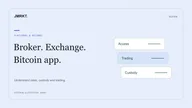
Broker, exchange and Bitcoin app describe different aspects of an offering. Your decision needs three answers: what product are you buying, who controls the balance and how can you transfer it later? The app name alone does not answer these questions.
A centralized exchange matches buy and sell orders; a broker intermediates or quotes a purchase price. Both may provide custody themselves or use partners. Bitcoin-only describes the supported asset. A hardware wallet manages keys and signs transactions, independently of the trading venue.
“App” does not automatically mean self-custody.
Always compare the same intended action: buying, custody or withdrawing to your own wallet.
Exchange
Orders and usually safekeeping with the provider.
Brokers
surface. Keys often with the partner.
Device
Key offline, trade elsewhere.
The four roles
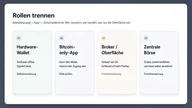
Central Exchange (CEX). You see order book or simple buy. The provider usually keeps the keys. Withdrawal is a second step, often with limits and identity verification. Product access (Spot, Derivatives, Earn) depends on the region.
Depending on the offering, brokers handle intermediation, pricing and settlement of a purchase. Trading and custody may involve different contractual partners. Check the terms and information about the custodian alongside the pricing overview.
Bitcoin-only app. The name describes the asset, not the custody. There are self-custody apps, hybrids and pure access to a broker. Without the key question, the label remains empty.
Hardware wallet. Signed offline. Buying and selling still happens via an exchange, a broker or peer-to-peer. The device does not replace the marketplace — it separates the key from the marketplace. Basics: What is a Hardware Wallet?.
How you check the role
- Who can authorize transactions, and how is access recovered?
- Does the terms and conditions or help state who holds the crypto holdings (provider, partner bank, smart contract)?
- Is payment to your own address documented, including deadlines and limits?
- Which permit or register entry is mentioned - and does it apply to my country?
A visible seed phrase is not a complete custody test. Wallets with other backup methods can also support self-custody. What matters is who can authorize transactions and how access is recovered. For a custodial provider account, also consider withdrawal terms and counterparty risk.
Fees only if the scope is the same
Fee comparisons only occur if the scope of services is comparable. An app with a spread in the purchase price, an exchange with maker/taker and a Perp-DEX with funding are not three numbers in one line.
Card programs often sit on an exchange or broker. The card fee is a second bill. For this: Crypto cards in everyday life.
Regulation in Germany, Austria and Switzerland
Oversight and product access are country specific. MiCA CASP entries in ESMA register are publicly verifiable - they are not a recommendation or legal advice. For us, information is often missing “under review”, not as “unregulated” and not as “free”.
Five unranked platforms: Crypto platforms at a glance (2026). Leverage products play a different role again: Understanding perpetual DEXs.
Differentiate roles in everyday life
Almost every app looks the same in onboarding: account, identity verification, purchase button. The role sits underneath.
Are you buying an order book or a spread? A CEX often shows maker/taker. A broker often shows a purchase price with a margin. Both can move Bitcoin. It's not the same contract. The cells are in Crypto exchange comparison and in the short list Crypto platforms at a glance.
Do you control access yourself? Check the wallet’s signing and recovery rules. An exchange login and a connected wallet can coexist: the exchange account balance remains separate from the balance at your own address. Connecting a hardware wallet alone does not transfer coins.
Further reading: What is a Hardware Wallet?.
Is crypto the product or a shelf next to it? Crypto ETP securities brokers and a spot exchange share the app icon, not the item. Scalable Capital is the teaching case in Brokers in Germany, Austria and Switzerland vs international exchanges: ETP, no native spot order book, no payout to your own wallet.
Is there a card on the roll? Then a second invoice is added - spread, FX, ATM - without the custody changing. Crypto cards in everyday life.
Leverage and perps are another role with liquidation. They do not belong in the same line as a recurring investment plan: Understanding perpetual DEXs.
Bitcoin-only: check asset selection and custody separately
“Bitcoin only” describes the asset set, not the quality of custody and not the quality of fees.
A Bitcoin-only app focuses on Bitcoin. Its documentation determines whether it offers broker access, a wallet or both. The narrower asset selection may fit your needs; it does not establish anything about fees, custody or security.
Further reading: 21bitcoin.
What Bitcoin only not says:
- not who holds the key
- not whether payment to your own address is documented
- not whether a MiCA CASP entry applies to your country
- not whether the spread is cheaper than maker/taker
The test questions above remain the same. Scope narrows the product range. Kindness would be a grade - we don't give it. If you only want to buy Bitcoin, filter. If you want other assets later, read the asset cell before the scope becomes a trap.
A takeaway: The app icon is the weakest piece of information on the screen. Key, payout, cost model and register entry are the strong ones. Bitcoin-only only changes the asset column. It doesn't change whether you see a seed, whether SEPA comes before KYC, or whether an ETP ends up in the depot instead of a coin.
You can compare broker and order-book exchange costs using the same purchase amount and end state. Calculate how much Bitcoin arrives after deposit, purchase and any withdrawal. Spread, trading fees and withdrawal costs are different components of that total. An ETP is a security, so coin withdrawal is not an equivalent comparison point.
Further reading: Scalable Capital, Brokers in Germany, Austria and Switzerland vs international exchanges, Crypto exchange comparison.
A MiCA CASP entry in ESMA register is readable. It is not goodness and is not a guarantee of payout. If we don’t provide this information, it says “under review”.
In practice: classify an offering in three steps
Start with the purchase object: a transferable coin, a security or a derivatives position? Then read which contractual partner provides trading and custody. Compare the displayed price and additional costs after that.
A later move requires a documented exit route. Check supported assets and networks, withdrawal fees, minimum amounts and possible waiting periods. If self-custody is your goal, preparation also includes a reliable backup method for the destination wallet.
Frequently asked questions
Is an exchange with a hardware wallet connection self-custody?
Only when the key is on the device and the exchange doesn't have to hold it. A purchase on the exchange stays there until you cash out and sign yourself.
Why does almost every app advertise security?
Because the word is non-binding. Ask about the key, payout and register — not the adjective.
Is a Bitcoin-only app enough instead of a hardware wallet?
That depends on the custody of the app, not the name. Some are self-custody, some are not. The hardware wallet is a device, the app is a program - often with a network.