Perpetual DEXs: Margin, Liquidation & Custody Explained
Understand perpetual futures on DEXs: distinguish position value, margin, funding and liquidation, and assess technical dependencies.
In this guide

Perpetual futures provide price exposure without a fixed expiry date. They allow long and short positions whose value may exceed posted collateral through leverage. On a decentralized platform, technical dependencies accompany market mechanics. This guide explains the terms and a traceable review sequence.
Margin buffers losses. Isolated means: a position pot. Cross means: common pot. When the margin is no longer sufficient, the protocol liquidates — often abruptly. Funding periodically balances long and short and can flow in either direction.
Control of a wallet and the safety of a derivatives position are separate questions.
Perp
No due date, but funding.
Margin
Buffer. Isolated or shared (Cross).
end
Liquidation can take away the stake completely.
What a Perp is — and what it isn't
A perpetual future shows a price without ending on a date. You go long or short with leverage. The bet is margin, not the face value of the position. Profits and losses are based on the protocol's mark price - which may differ from the spot price.
This is not a spot purchase. You don't own the underlying asset, just a position in the contract. That's why Perps do not replace a hardware wallet or an exchange withdrawal. Roles: Broker, exchange, Bitcoin-only app.
The position lies centrally (CEX) with the provider. It is located decentrally in the contract, which you address via a frontend. Both can lead to total loss. The difference is the counterparty: company or code — plus the frontend you click on.
Initial margin, maintenance margin and margin mode
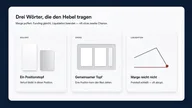
Isolated: Only the buffer stored for this position is liable. Another position remains untouched - until you switch yourself.
Cross: Multiple positions share margin. A bad one can drag the others along with it.
Liquidation: If the buffer is not enough, the protocol closes. There is often no human grace period. Slippage and closure fees are part of the loss.
Leverage describes the ratio of position value to posted collateral. For an unchanged position, a price movement affects the entire position value. The liquidation threshold, however, depends on specific margin rules, fees and other account movements. A leverage figure alone therefore does not provide a reliable liquidation price.
Funding
Funding is a periodic payment between long and short to keep the perp price stuck at the spot. You can receive or pay funding — depending on the market and site.
A “free” leverage without a funding line is incomplete. In quiet markets, funding is small. In one-sided markets, it is the hidden fee that eats up the position, even without the price going against you.
What self-custody means here
On a decentralized platform, a wallet may authorize transactions directly. Posted margin then follows the venue’s rules and technical dependencies. Self-custody alone therefore does not ensure uninterrupted or loss-free access. Relevant dependencies include:
- Errors or attacks in the smart contract
- Oracles that provide the mark price
- Bridges if margin assets are wrapped
- A frontend that shows a different transaction than the contract executes
- Your own confirmation
A hardware wallet changes the signature authority, not the market mechanics. What a hardware wallet really protects This is particularly true here: The chip does not check whether the contract does what the website promises.
Scope and limits of this guide
Leverage products can lead to a total loss. Protocol, bridge and frontend risks are part of the story. We do not choose a “safe” Perp-DEX.
The position over time: price, costs and remaining collateral
A position changes during its lifetime even without a new order. Price movements affect unrealized profit or loss; fees and funding alter the calculation further. Check these quantities alongside minimum collateral requirements. The displayed mark price may differ from the most recent traded price.
Margin is the buffer, not the face value. Only this pot is insulated. Cross shares the pot with other positions. The choice is in the documentation of the protocol, for example Hyperliquid, dYdX or GMX. We don't use leverage numbers as a strategy here. “10x” is a distance from the line, not a recommendation.
Funding is the periodic payment between long and short so that the perp sticks to the spot. You can receive them or pay them. In one-sided markets, it eats up the position, even without the price going against you. A frontend that writes Funding in lower case does not change the mechanics. The line belongs in the cost accounting alongside trading fees and slippage.
Liquidation closes if the buffer is not enough. There is often no human grace period. Slippage and closure fees are part of the loss. The mark price may differ from the spot; the Oracle provides it, not your desired price.
The three hang: Less margin means closer to the line. Funding changes the buffer over time. Liquidation ends the bill. If you only read the lever, you read the smallest of the three numbers.
Self-custody doesn’t cancel that out
Technical review requires more than a wallet connection: where is margin held, which components determine the price, and which routes are available for closing and withdrawing? Also check dependencies on bridges, collateral assets and the interface. Specific architecture differs by protocol.
A hardware wallet changes the signature authority. It doesn't change:
- the line below which the protocol closes
- the funding rate of the period
- Oracle, Bridge and Frontend Risk
- your confirmation of a contract that the display does not translate into plain text
What a hardware wallet really protects This is particularly true here: The chip does not check whether the website does what it claims. Separate rolls beforehand: Broker, exchange, Bitcoin-only app. Spot buying and Perp are different products; they stand in the same comparison world only as different types of platforms, not as a grade.
We do not choose a “safe” Perp-DEX. Leverage products can lead to a total loss. The catalog lines - not this text - bear the characteristics.
Isolated limits damage to one position — until you redeploy margin yourself. Cross makes exactly that the default: a bad position can empty the common pot. The choice is in the protocol documentation, not in this text as a strategy. Read the liquidation and funding pages Hyperliquid or dYdXbefore reading a number in the frontend as a “safe distance”.
Here, self-custody means: You sign. It doesn't mean that funding is paused or that the line is waiting. A hardware wallet on the Perp frontend changes the signature counterparty, not the market mechanics. Roles before: Broker, exchange, Bitcoin-only app. Spot CEX and Perp DEX are in Compare crypto exchanges as different platform types.
Worked example: distinguish position value from collateral
An illustrative linear long position worth 1.000 euros is opened with 100 euros of collateral. Initially, that is ten times the collateral. A 2 percent price decline produces a calculated price effect of 20 euros: 2 percent of position value and 20 percent of original collateral. Fees and funding are excluded from this example.
This example does not establish a specific liquidation price. That requires the product’s maintenance margin and other rules. Before a position, check position value, collateral asset, margin mode, price source, ongoing costs and the consequences of automatic closing.
Frequently asked questions
Is a DEX automatically safer than a CEX?
Risk distribution depends on the specific architecture. Your own signatures may coexist with dependencies on the protocol, price sources, bridges and service providers. The label DEX alone is no security guarantee.
Can I prevent liquidation with a hardware wallet?
No. The device signs. The line is drawn by the protocol as soon as the margin is not enough.
Is it enough to ignore funding?
Check funding direction, calculation basis and settlement interval even for a position planned to be brief. Delays in closing and rate changes may affect the calculation. Assess funding alongside price effects and trading costs.