Perpetual Futures Liquidation: How to Read the Numbers
Explain liquidation in perpetual futures: isolated and cross margin, mark price, funding and maintenance margin with a clear review sequence.
In this guide
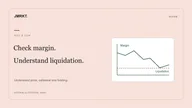
A perpetual position may be closed automatically when required collateral is insufficient. Margin mode, price source and ongoing costs matter. This guide explains which information to check before and during a position and why a funding rate is not a reliable return promise.
Further reading: Understanding perpetual DEXs.
APY, saveback and yield banners are not included in the perp calculation. If you're looking for an overall DEX grade, you won't find one here.
The liquidation threshold depends on position rules and available collateral.
Read the cost rows together with the margin and liquidation rules; they answer different questions about the same position.
Isolated
A position pot. Loss stays there — until you shift.
Cross
Shared pot. One position can take the rest with it.
Funding
Periodic payment. No APY and no recurring investment plan replacement.
Liquidation risk: interpret comparison information

In Crypto exchange comparison you filter platform_type=perp_dex. The column then shows Hyperliquid, Aster and Lighter as Perp-DEX. What the table not replaced: the liquidation logic of the respective protocol. The loss cell is the reading — leverage, margin mode, funding and what happens when the buffer is empty.
Spot brokers and CEX solve a different everyday life. If you only want to buy spot, stick with broker and CEX chips. Perp-DEX is a margin product with protocol risk, even if the payout to your own wallet is in the feature cell Yes stands.
A second reading error: do not equate paying out your own wallet with any liquidation risk. The feature cell describes the exit on-chain, not the margin line. Likewise: KYC none does not mean anonymous and risk-free - only that our snapshot does not document a KYC level.
The Methodology crypto exchanges does not assign an overall score. This text does not invent a “safest DEX” or return path.
Start with the specific product and account mode. Then check which collateral is allocated to the position, which price is used for risk calculations and how ongoing costs are charged. The comparison description is a starting point; product-specific rules are in the linked documentation.
Isolated and cross: which collateral is affected

Isolated means: The margin sits in one position. If the price falls against you, only this pot can be liquidated - as long as you don't add or redeploy yourself. The rest of your account will remain disconnected until you unlink it.
Cross means: Several positions share the same buffer. A bad position can empty the common pot and drag other positions along with it. Cross feels generous until the line comes.
No mode is “safe”. Isolated limits the radius. Cross increases the coupling. The choice is in the protocol interface and documentation — not in an affiliate badge. The guide Understanding perpetual DEXs names the terms; The sequence of losses counts here: Check default before the first click (Isolated or Cross). Some surfaces save the last mode. A change without looking at open positions is the most common shortcut to the common loss cell.
Funding is not income
Funding is the periodic payment between long and short so that the perp sticks to the spot. You can pay or receive — depending on the market and site. That is none APY, no savings interest and no saveback.
A front end that frames funding like a return line does not change the mechanics. Funding received is a counter-entry from the other side, not a return from the protocol equity. Paid funding eats up the buffer, even if the price is stable.
Funding therefore belongs in the cost calculation alongside trading fees and slippage. Keep ongoing costs separate from margin risk; a positive account balance alone does not explain the distance to liquidation.
APY banners and points programs are marketing frameworks. They do not replace the mark price or liquidation threshold. In this text they do not count as a benefit argument for a Perp-DEX.
If a screen mixes Funding and Points on a line, mentally separate them: Funding now changes the buffer. Points may change a later reward — or nothing binding at all. The loss cell only knows the buffer.
Read liquidation
Liquidation is triggered by required minimum collateral, not necessarily only when the account balance reaches zero. Closing may be partial or complete depending on the protocol. The protocol-defined mark price is relevant to the trigger; the last traded price alone is insufficient for assessment.
Review an automatic closing against documented rules and transaction data: margin mode, mark price, required minimum collateral and actual costs charged. A liquidation alone does not establish the cause of a technical issue or the reliability of the entire venue.
Read the loss cell like this: (1) Which margin mode? (2) How close is the mark price to the line? (3) Does funding run against the buffer? (4) What does the protocol help document for liquidation? Only then compare product pages.
A retrospective review requires the account state before closing. Keep available order and settlement data and distinguish price loss, funding, trading costs and the closing event. For cross margin, include other positions because they may affect the same collateral pool.
After a liquidation, the checklist helps more than finding blame: Which mode was active? Which mark price source does the documentary mention? Was funding against you? Were there margin calls or auto-deleverage indications? The answers are in the protocol and UI history — not in an affiliate text. We claim no live trades and no reconstructed tick charts.
Three documented platforms and their own rules
The compare column with Filter Perp-DEX lists three documented programs. Everyone in our stand carries: platform type Perp-DEX, multi-asset, payout own wallet Yes, recurring investment plan No, MiCA unclear, KYC none. These are documented characteristics — not a recommendation.
-
Hyperliquid — Liquidation and funding details in the manufacturer documentation, not as an APY cell in our snapshot.
-
Aster — same characteristic line; Loss cell analogue: margin mode and liquidation first.
-
Lighter — different surface, same basic mechanics isolated/cross and funding.
We don’t choose a “best DEX”. Fee and liquidity differences belong in the columns and manufacturer help — not in an editorial note. We do not claim live trades.
Three identical feature lines do not mean three identical products. Order book depth, UI defaults and liquidation parameters may vary — and remain outside of our made-up numbers. What we prove: Platform type, asset scope, payout, recurring investment plan, MiCA status and KYC as far as the snapshot carries them. What we don't prove: a winner.
Keys are not margin
A hardware wallet or self-custody wallet on the Perp frontend changes who signs. It does not change the margin calculation. What a hardware wallet protects applies to key material — not the distance to the liquidation line.
Separate rolls beforehand: Broker, exchange, Bitcoin-only. Buy spot and trade perp are different platform types in the same compare matrix. Methodology and Keys: Methodology hardware wallets just as a demarcation — keys ≠ margin.
Anyone who has mastered the seed and hardware wallet has solved the signature side — not the margin side. A clean backup process reduces seed risk; it does not reduce the likelihood of Cross taking a second position. That's why the hardware methodology remains a demarcation here, not a trading tip.
In short: the loss cell does not answer which DEX wins. It answers whether you read Isolated or Cross, whether funding hits the buffer, and whether liquidation is told as a protocol step or as a crypto exchange scandal. Only the first reading belongs in this text.
After the cut, the reading order counts more than finding the blame: margin mode, mark-price source, funding direction, then distance to the line. Anyone who just adds the lever later leaves the bill unfinished.
Sources and limits of the assessment
We do not list a test winning DEX. We do not sell APY as a perp benefit. We claim no live trades and no guaranteed distances. We do not replace the Perps concept guide; we read the loss cell.
Compare: Perp DEX filter. Concept: Understanding perpetual DEXs. Rules: Crypto exchange methodology.
In practice: read a position overview systematically
Read position size and margin mode first. Then check available equity, required minimum collateral and mark price. An estimated liquidation price can change with costs or other positions. A stop order is a separate order and does not guarantee execution or a particular price in every market movement.
Separate the calculation by purpose: trading fees relate to opening and closing, funding to holding time and margin to loss absorption. Funding received may exceed a price loss or fall far short of it. Assess the entire position risk and do not annualize one periodic payment as a guaranteed return.
Frequently asked questions
Is isolated always safer than cross?
No. Isolated limits the radius of a position. Cross couples buffers. Neither mode cancels liquidation.
Is Funding the same as APY?
No. Funding is a periodic payment between long and short. APY framing does not belong in the perp loss cell.
Does self-custody protect against liquidation?
No. It protects against some key custody risks. Funding and liquidation continue under the contract.
Which Perp DEXs are in the comparison table?
Hyperliquid, Aster and Lighter carry platform_type=perp_dex. This is not a leaderboard.
Does this text replace the Understanding Perpetual DEXs guide?
No. The concept guide explains the terms. This is about isolated/cross, funding without APY and reading the liquidation.
Is there the best Perp DEX?
Overall no. The table sorts according to documented characteristics, not according to an editorial note.