Withdraw crypto to your own wallet: network, address and fees
Transfer crypto from an exchange to your own wallet: check withdrawal support, network, address, minimum amount and fees.
In this guide
The comparison table sorts regardless of affiliate commission — see Methodology: Crypto Exchanges. This text does not choose a test winner and does not replace your own practical test.
A crypto withdrawal transfers coins from a provider to a destination address. The platform and your wallet must support the same asset and transfer route. This guide explains preparation, costs and the limits of comparison data. The coins remain on the network; the wallet manages access.
Check recipient details independently of the purchase price. An incorrect address, unsupported network or missing memo can jeopardize access to the transfer. A device with a trusted display supports verification; you still need to compare the displayed details with the intended recipient.
Further reading: What Does a Hardware Wallet Protect? Risks & Limits, Hardware Wallet Seed Phrase Backup: BIP39 & SLIP39.
The roles — who holds the key, who is just the surface — are in place Crypto Broker vs Exchange vs Bitcoin App: The Differences. This is about one Cell and the path from this cell into the hardware wallet hub. All labels are below Catalog status 2026-08-15, no own measurement and no laboratory report.
Withdrawal
Documented exit — no promise of arrival.
Product type
Scalable: ETP, payout no.
Address verification
Address on hardware wallet display.
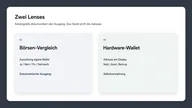
Pros/Cons Pay out instead of leaving it lying around
Pros
- The platform's counterparty risk decreases as soon as the output is in an address whose seed you hold. Third-party custody remains third-party custody as long as the coins are on the exchange - the CASP label does not change that.
- The catalog line makes the difference visible: BISON free of charge, Scalable Capital No, others with a hefty fixed amount or “plus network fee”.
- Lightning cells (21bitcoin, Kraken) are a different path than on-chain — marked as such in the characteristics, not stopped by us.
Cons
- Network fees and minimum amounts can eat up the “cheap” purchase. The scenario line Costs (EUR 1,000 one-time purchase) doesn't take that into account.
- Wrong address, wrong network, test amount skipped: the device doesn't help. We describe this as a risk, not as a drill being carried out.
- Some products are not a coin outlet. Scalable: ETP, payout No. Anyone who wants self-custody and only sorts the cost column will end up exactly there.
The catalog line (15.08.2026)
Hub: Crypto exchange comparison. Broker cut: same table with broker filter. Filter hook in the hub: Payout from your own wallet.
| product | Payout your own wallet (catalog) |
|---|---|
| BISON | Yes · free |
| 21bitcoin | Yes · 0.00005 BTC · Lightning |
| Bitpanda | Yes · 0.0001 BTC |
| Kraken | Yes · 0.00015 BTC · Lightning |
| Trade Republic | Yes · plus network fee |
| OKX | Yes · plus network fee |
| Coinbase Advanced Trade | Yes · plus network fee |
| Scalable Capital | No |
The table documents the catalog as of 15 August 2026. Yes indicates the withdrawal function recorded then, not every asset-network combination. Fee figures are historical provider information. Read the current withdrawal overview immediately before a transfer: fees, minimum amounts, available networks and waiting periods can change.
Perp-DEX rows do not belong in this table. Anyone looking for margin and liquidation reads Perpetual DEXs: Margin, Liquidation & Custody Explained, not this withdrawal text.
Distinguish coin withdrawals from crypto ETPs
A crypto ETP is a security held in a securities account. The Scalable route described in the catalog therefore does not offer withdrawal of that position as Bitcoin to your wallet. Check the specific purchase object and its terms before comparing it with coin withdrawal offerings.
This is not a judgment against the product. An ETP can fit into a securities portfolio, bring a native tax report and still none Be Bitcoin that you send to a hardware wallet. According to features: Payout your own wallet No. SEPA deposit: bank transfer only, without the card and instant lines that neighbor apps carry.
The same logic is in the broker lens and on the Scalable product page. Germany, Austria and Switzerland versus CEX in the cells: Crypto Brokers in Germany, Austria and Switzerland vs International Exchanges. Unranked brands: 5 Crypto Platforms: An Overview for 2026.
Regulates ≠ your coins. CASP or Sitz DE says nothing about whether you hold coins. Scalable can be a supervised broker and still not have a coin exit. BISON or Kraken can be CASP authorized and still hold the coins in third-party custody as long as you don't cash out.
The purchase price and payment are two invoices
The methodology calculates in Costs (EUR 1,000 one-time purchase) BTC/EUR, market order or taker, basic level, without volume discount. One-time purchase means: one-time amount, coins remain on the platform. Payout is a second line.
Catalog status 2026-08-15, purchase line (without Trade Republic — costs Unknown, not an estimate):
| Platform | Costs (EUR 1,000 one-time purchase) | Cost model |
|---|---|---|
| 21bitcoin | EUR 14.90 · 1.49% Spread | spread |
| BISON | EUR 12.50 · 1.25% Spread | spread |
| Bitpanda | EUR 14.90 · 1.49% Spread | spread |
| Scalable Capital | EUR 10.89 · EUR 0.99 Flat + 0.99% | Spread + Flat — and none Withdrawal |
| OKX | EUR 1.00 · 0.1% Taker | Order book |
| Coinbase Advanced Trade | EUR 6.00 · 0.6% Taker | Order book |
| Kraken | EUR 8.00 · 0.8% Taker | Order book |
Anyone who buys BISON at EUR 12.50 Spread and withdraws for free according to Zelle has a different all-in bill than whoever buys OKX at EUR 1.00 Taker and then pays “plus network fee” — in both directions. We don't add this to a total cost line because the network fee is often open in the features. A made-up on-chain fee would be a measurement claim.
21bitcoin 0.00005 BTC and Bitpanda 0.0001 BTC are fixed values of the cell. Whether they are still valid at the time of purchase is stated in the table, not in this sentence. 0.0001 BTC Fix plus a small spot purchase can eat away the benefit of the withdrawal. This is arithmetic on the cell, not “we moved and measured EUR 80”.
Sources of fee cells (catalogue, not our measurement): 21bitcoin Fees, BISON fees, Bitpanda Fees, OKX Fees, Kraken Fee Schedule, Coinbase Advanced Trade fees, Scalable trading fees.
Lightning is another way
Lightning is in the features of 21bitcoin and Kraken. This is an in-cell network option, not a quality assessment and not a throughput test.
A Bitcoin on-chain address and a Lightning payment request are different recipient details. Select the documented transfer route and obtain the intended details from your destination wallet. Support for a Bitcoin key on a device alone does not establish a complete Lightning payment route.
“Lightning” in the crypto exchange cell does not mean “secure arrival” and does not mean “free on the internet”. It means: the catalog documents this exit path. You can check there whether the invoice, channel or minimum amount in the app looks different than the cell. We haven't drawn an invoice.
What “own wallet” means in the line
In the line is the own Wallet meant, not the spot balance on the platform. An exchange wallet with your login is third-party custody. Proof of Reserves doesn't change that. PoR is a transparency cell, not bankruptcy protection and not a substitute for payout.
According to characteristics, without your own attestation check: Kraken and Coinbase Advanced Trade third-party certified, OKX self-certified, 21bitcoin/BISON/Bitpanda none, Scalable and Trade Republic Unknown. Self-certified is not third-party certified. “None” is not an allegation of fraud. We don't build a security ranking from these four words — and no reason to leave coins lying around or move them.
With self-custody, you control access through the wallet’s intended signing and recovery route. That does not necessarily use a visible seed phrase. After a withdrawal, backups, supported networks and transaction verification still matter.
Recipient details: address, network and memo
For a model with a display, use the documented receiving-address verification on the device. Compare that address with the withdrawal request’s recipient details. For other device architectures, follow the intended verification process. The wallet cannot itself decide whether the selected recipient matches your intention.
Further reading: What a hardware wallet really protects.
What you need to clarify before the first payout — as a checklist, not as “this is how we did it”:
- Asset and network: Both sides must support the same transfer. Format validation alone does not prevent an unsuitable network selection.
- Recipient: Verify the full address and any required memo or tag.
- Test amount: Account for minimum amounts and fees and verify actual receipt.
- Net amount: Establish how much should arrive after withdrawal fees.
- Backup: Establish the complete recovery route for your destination wallet.
Further reading: Save seed phrase.
Memos and tags (where an asset needs them) are not in the BTC row of the table. Anyone who moves other assets reads the product page and the platform UI. We do not invent a memo requirement for Bitcoin and an ERC-20 guide.
We are not describing a “this is how BISON sends on Trezor” click path here. That would be a practical claim without evidence. The two tables only say: Output documented / input is a device with address display.
Prepare the destination wallet
Your own wallet is often a hardware wallet. Pool and filters: Hardware wallet comparison. Methodology: Methodology hardware wallets. Profile questions without making this text a filter FAQ: How to Choose a Hardware Wallet: An Interactive Guide.
Example paths into the device, no recommendation and no “suits to BISON”:
- USB entry multi: Trezor Safe 3 (Open source USB wallet)
- Mobile/iPhone proximity: BitBox Nova
- Bitcoin-only argument: BitBox02 Bitcoin-only, Blockstream Jade
Bitcoin-only vs. Multi: Bitcoin-Only vs Multi-Coin Hardware Wallets. If you only move BTC, you filter in the HW hub; whoever wants EVM later reads the same table differently. This withdrawal text doesn't decide that.
How to filter in the hub
- Open that Crypto exchange comparison.
- chip Entry-levelif you want broker/app. chip Spot CEXif you want an order book. Perp DEX out.
- Hook Payout from your own wallet, if self-custody is the condition - Scalable then predictably falls out. Leave the line once without There are hooks so that the teaching case remains visible.
- Read Order types, before forcing Scalable into the same tray alongside Kraken.
- Buy line and payout line not Add to a total cost number as long as “plus network fee” is open.
- Two regional broker rows plus one CEX line into the tray. Eight columns at once create fog.
- Second lens: Hardware wallet comparison. Address on the device, not in the browser extension.
Example paths (no ranking)
Path A — regional broker with documented free withdrawals
BISON → Hardware Wallet Lens. The native tax report is in a different column; The only thing that counts here is the exit. Spread 1.25% on the buy line is the purchase, not the withdrawal.
Path B — Lightning Cell
21bitcoin or Kraken, if the Lightning information is still in the characteristics. On-chain address is another way. 21bitcoin is Bitcoin-only app (n/a (nur BTC/EUR) in the asset column), not a small Kraken.
Path C — CEX or broker, fee variable
OKX · Coinbase Advanced Trade · Trade Republic: “plus network fee”. Read the amount in the platform's app, don't make it up here. TR purchase costs remain Unknown — we don’t build a “cheap plus network” story out of it.
Path D — intentionally no withdrawal
Scalable Capital. ETP. Not in the same tray as “Coins to the cold wallet”. If you only see the 10,89-€ rate, you have skipped the order type cell.
In practice: prepare a transfer and verify receipt
Generate the receiving address in your destination wallet and select the matching network at the provider. Verify the full address and, where required, the memo or tag. A correctly formatted address does not prove that the network and recipient are correct. For hardware wallets, follow the manufacturer’s documented verification process.
A small initial transfer can test the selected route if minimum amounts and fees allow it. Check the amount actually received and the status in the destination wallet. Verify recipient details again before every further withdrawal; an earlier successful transfer does not guarantee a later one.
Checklist immediately before a payout
- Asset and network: Check the specific combination with the provider and in the target wallet. A general payout function is not a receipt for every coin.
- Recipient details: Take the address from your wallet and fully control it. Any memo or tag that may be required is included in the recipient information.
- Minimum amount and fees: Read the amount deducted and the actual amount received. An unknown network fee is not zero.
- Status: After the order, check the transaction ID and the specified status. A displayed request is not yet confirmation of receipt.
For a specific purchase: Buy Bitcoin, Buy Ethereum or Buy Dogecoin. There, the asset-related purchase availability remains separate from the payout conditions.
Frequently asked questions
Which payout is the cheapest?
That depends on current provider pricing, asset, network and amount. The table shows historical entries from 15 August 2026. Before the request, compare total deductions and the quantity received; an unknown fee is not zero.
Can I send from Scalable to a Ledger?
According to characteristics, no. This follows from the ETP path, not from a missing button that we missed.
Is the exchange wallet sufficient as a “own wallet”?
No. The line refers to your own wallet. Login plus app is third-party custody.
Do you have to see the test amount for the article to be valid?
No. We list the cell. We do not claim an executed transaction.
Does the tax belong in the same piece?
No. Export formats: German Crypto Tax Reports: Native Reports, CSV & API. Paying out changes tax issues; we don't answer them.
Does the cell change?
Yes. Network options and fees are subject to change. Check the provider's source status and payout overview immediately before a transfer.
Do I need a hardware wallet or is software enough?
Your own wallet can operate through hardware or software. Access control, a matching network and a reliable backup route matter. Architectures differ in key management and transaction verification; withdrawal support does not prescribe a particular device.
Is SEPA withdrawal the same as on-chain?
SEPA transfers euros to a bank account. An on-chain withdrawal transfers a supported coin over the selected network to an address. For self-custody, access to that destination address must be under your control. Check the payment route, asset and recipient details separately.
Why a test amount first?
A small initial transfer can show whether the selected route reaches the destination wallet. It may incur additional fees and must meet the minimum amount. Verify actual receipt and check recipient details again before every further request.
Crypto assets are subject to high risks, including total loss. Not investment, tax or legal advice.