Stablecoin Yields 2026: EURC & USDC Risk Check
On euro stablecoins, large lending protocols pay around 1.5 to 3.5%, without leverage or bonus, but also without deposit insurance. Where 5 to 8% comes from, which offers work in Germany and how risky they are. With partner links to ether.fi, Kraken, Bitvavo, OKX and Trade Republic.
In this guide
In short: a euro stablecoin does not pay interest by itself. If you lend EURC through a large lending protocol, you get around 1.5 to 3.5% a year on 19 November 2026, so on average roughly the ECB deposit rate of 2.50%. Anything significantly above that comes from leverage, currency trades, loans to companies or a bonus that the provider can change at any time.
Colloquially, these earnings are called stablecoin interest; legally they are mostly income from lending or “rewards”. We state the rates as APY, i.e. as an annual yield with compounding. This page shows the status as of 19 November 2026: which offers exist for people in Germany, where their yield comes from and how we rate the risk on a scale of 1 to 5. We update the values as the occasion arises; each offer shows the date of the last check. This is not investment advice, and none of the rates is promised.
Euro baseline
Euro stablecoins in DeFi 1.5 to 3.5%, ECB deposit rate 2.50%, overnight money 2.25 to 2.50%.
Above that
In euros 5 to 8% only with a bonus, carry trade, leverage or corporate loans. Dollar loans pay around 4 to 5%, plus exchange rate risk.
Protection
No deposit insurance for stablecoins. Values as of: 19 November 2026.
Does a euro stablecoin pay interest itself?
No. In the EU, EURC, EURCV and EURe are e-money tokens, and so is USDC. The MiCA Regulation prohibits their issuers from paying interest on them (Art. 50(1)). The same applies to crypto-asset service providers when they provide services related to e-money tokens (Art. 50(2)). Interest means any remuneration that depends on how long you hold the token, even if it flows through third parties or the pricing of other products (Art. 50(3)).
The issuers comply. Monerium states that it pays no interest and offers no returns on its e-money tokens. Circle states for EURC that Circle bears the interest rate risk of the reserves; the page does not provide for passing interest on to holders. Yield only arises once you pass the stablecoin to someone who puts it to work.
Where does the yield on stablecoins come from?
Behind every offer there is at least one of six sources, often a mix. The range shows what we saw on 19 November 2026; the values for government bond funds date from 6 November 2026.
| Source | How it works | Examples | Range | Main risk |
|---|---|---|---|---|
| Over-collateralised loans | Borrowers post more collateral than they borrow and pay interest | Aave, Morpho, Jupiter Lend | EUR 1.5 to 3.5%, USD 4 to 4.7% | Smart contract, tight liquidity |
| Loans to companies | A platform or protocol lends to traders or firms | Bitvavo, OKX, Bybit, Maple | EUR 1.5 to 4%, USD 1 to 5.2% | Borrower defaults, platform insolvency |
| Government bonds and tokenised funds | The money sits in short-dated bonds | Money market funds, BlackRock BUIDL, parts of RWA vaults | EUR around 2.8%, USD around 3.6 to 3.9% | Issuer, access often limited to professionals |
| Strategies with leverage or carry | A manager borrows on top, swaps currencies or uses interest rate differences | ether.fi Euro Yield and Bold, Ethena (not in the EU) | 5 to 8% | Liquidation, exchange rate, manager |
| Insurance risk | Investors bear losses from reinsurance and receive premiums for it | OnRe ONyc | around 11% | Large loss events |
| Bonus and token rewards | The provider adds something for marketing reasons | Bitpanda (up to 4% bonus), Usual | 0 to 4% extra | Disappears whenever the provider wants |
The most important connection: euro loans pay less than dollar loans because short-term interest rates in euros are lower. A euro money market fund returned around 2.8% on 6 November 2026, tokenized US government bonds 3.6 to 3.9%. Anyone who pays you significantly more in euros than the ECB deposit rate is either taking more risk or paying out of their own pocket.
What yield is there on EURC and other euro stablecoins?
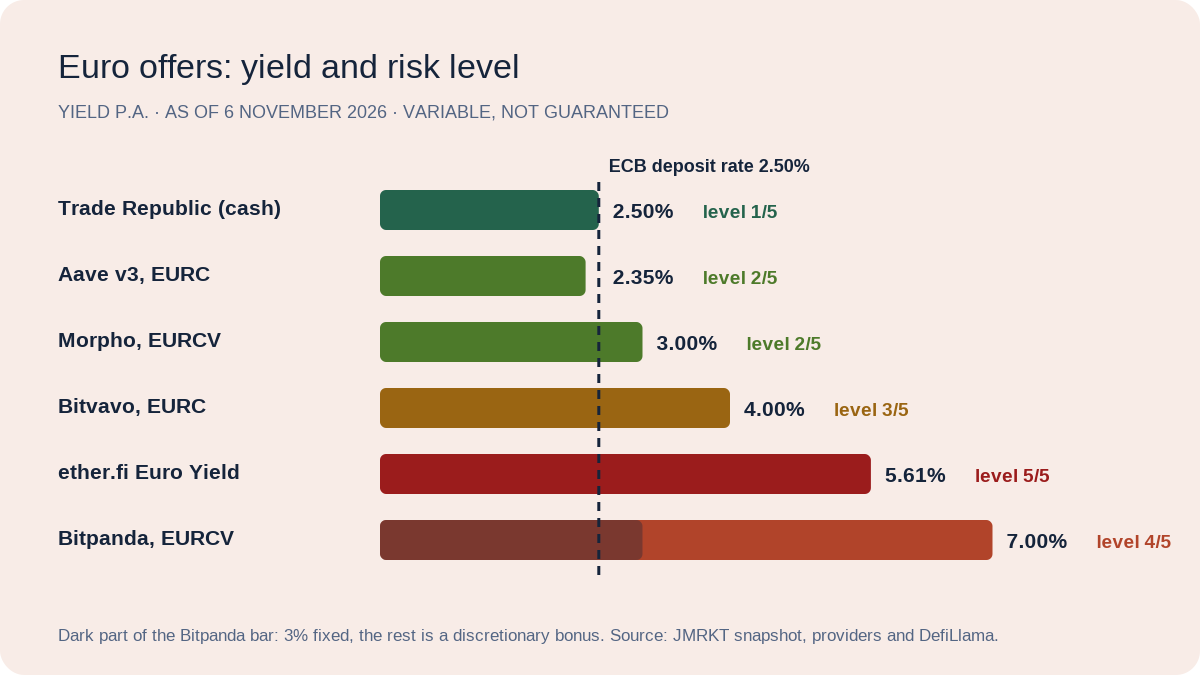
The table shows all euro offers we checked for people resident in Germany, plus two savings accounts for comparison. The gap to the ECB deposit rate is given in percentage points. It is sorted by type of offer, not by yield or risk. How the risk level is set is explained further down and in the Methodology.
| Offer | Yield p.a. | Gap to the ECB deposit rate | Risk |
|---|---|---|---|
| Trade Republic interest on cashReferenceEuro cash, not a stablecoin | 2.50% | ±0,0 pp | Low 1/5 |
| Revolut savings accountReferenceEuro cash, not a stablecoin | 2.25% | −0,2 pp | Low 1/5 |
| Aave v3 (Ethereum)EURC | 2.59% | +0,1 pp | Moderate 2/5 |
| Aave v3 (Gnosis)EURe (Monerium) | 3.51% | +1,0 pp | Moderate 2/5 |
| Morpho, steakEURCV vault (Ethereum)EURCV (Société Générale-Forge) | 3.00% | +0,5 pp | Moderate 2/5 |
| Jupiter Lend Earn (Solana)EURC | 1.54% | −1,0 pp | Moderate 2/5 |
| Bybit EU, Flexible SavingsEURC | 1.50% | −1,0 pp | Elevated 3/5 |
| Bitvavo, EURC LendingEURC | 4.00% | +1,5 pp | Elevated 3/5 |
| Bitpanda, Earn on StablecoinsEURCV | 7.00% | +4,5 pp | High 4/5 |
| ether.fi Liquid, Euro YieldEURC | 5.61% | +3,1 pp | Very high 5/5 |
How to read the cards: the bar shows our risk level. Below it are the criteria that push the level up. "View criteria" shows each individual score.
Trade Republic interest on cash
ReferenceEuro cash, not a stablecoin- Source
- Interest from partner banks and dividends from money market funds, rate depends on the ECB deposit rate
- Withdrawal
- at any time
- Access
- available in Germany
Go to Trade Republic (partner link) ↗AdvertisingAdvertising: partner link. If you sign up through it, JMRKT may receive a commission. You pay nothing extra. The risk level does not depend on it.
Revolut savings account
ReferenceEuro cash, not a stablecoin- Source
- Bank deposit
- Withdrawal
- at any time
- Access
- available in Germany
Aave v3 (Ethereum)
EURC- Source
- Interest from borrowers who post more collateral than they borrow
- Withdrawal
- immediately, as long as unlent liquidity is available
- Access
- via your own wallet, no account; according to the terms only sanctioned countries are blocked
Aave v3 (Gnosis)
EURe (Monerium)- Source
- Interest from over-collateralised borrowers
- Withdrawal
- immediately, as long as unlent liquidity is available
- Access
- via your own wallet, no account
Morpho, steakEURCV vault (Ethereum)
EURCV (Société Générale-Forge)- Source
- Interest from borrowers in markets selected by a curator
- Withdrawal
- immediately, as long as liquidity is available
- Access
- via your own wallet, no account
View criteria
- Counterpartymedium
- Source of yieldlow
- Transparencylow
- Withdrawallow
Jupiter Lend Earn (Solana)
EURC- Source
- Interest from borrowers via Fluid's liquidity layer
- Withdrawal
- immediately, throttled by an automatic ceiling
- Access
- via your own Solana wallet, no account
Bybit EU, Flexible Savings
EURC- Source
- Bybit EU lending activities; according to Bybit the product is not regulated under MiCA
- Withdrawal
- at any time
- Access
- Account with KYC, not for residents of Austria
View criteria
- Counterpartyhigh
- Source of yieldmedium
- Transparencymedium
- Withdrawallow
Bitvavo, EURC Lending
EURC- Source
- Bitvavo only says "liquidity for the Bitvavo platform"; borrowers are not disclosed
- Withdrawal
- no lock-up according to the app
- Access
- Account with KYC
View criteria
- Counterpartymedium
- Source of yieldmedium
- Transparencymedium
- Withdrawallow
Go to Bitvavo (partner link) ↗AdvertisingAdvertising: partner link. If you sign up through it, JMRKT may receive a commission. You pay nothing extra. The risk level does not depend on it.
Bitpanda, Earn on Stablecoins
EURCV- Source
- Loan to Bitpanda with transfer of ownership; Bitpanda uses the coins as liquidity for margin trading
- Withdrawal
- Return on request with a 14-day lock, confirmed in the app on 06.11.2026
- Access
- Account with KYC; according to Bitpanda not a regulated product
View criteria
- Counterpartyhigh
- Source of yieldmedium
- Transparencymedium
- Withdrawalhigh
ether.fi Liquid, Euro Yield
EURC- Source
- 78.2% in a position called "EURC/USDC Carry", plus 16.1% euro loans via Morpho; ether.fi's fact sheet cites leverage and liquidation risk
- Withdrawal
- usually around 3 days according to ether.fi, without guarantee
- Access
- via the ether.fi app; Midas vault: funds in a Fordefi MPC wallet controlled by the manager; provider based in the Cayman Islands
View criteria
- Counterpartyhigh
- Source of yieldhigh
- Transparencymedium
- Withdrawalmedium
- Largest position78.2%
Go to ether.fi (partner link) ↗AdvertisingAdvertising: partner link. If you sign up through it, JMRKT may receive a commission. You pay nothing extra. Risk level 5 of 5: only deposit money you can afford to lose.
What yield is there on USDC and other dollar stablecoins?
Rates are higher in US dollars because dollar interest rates are higher. For euro investors, however, there is a risk that no APY shows: if the dollar falls against the euro, that can wipe out a whole year's yield or more. We therefore do not show a gap to the ECB deposit rate here.
| Offer | Yield p.a. | Risk |
|---|---|---|
| Aave v3 (Ethereum)USDC | 3.96% | Moderate 2/5 |
| Jupiter Lend Earn (Solana)USDC | 4.71% | Moderate 2/5 |
| Kraken DeFi EarnUSDC (euros are converted into USDC) | 5.10% | Moderate 2/5 |
| OKX Europe, Simple EarnUSDC (EURC is not supported) | 4.50% | Elevated 3/5 |
| Bybit EU, Flexible SavingsUSDC | 1.02% | Elevated 3/5 |
| Bitpanda, Earn on StablecoinsUSDC | 7.00% | High 4/5 |
| Maple, syrupUSDCUSDC | 5.23% | Elevated 3/5 |
| ether.fi Liquid, USD YieldUSDC | 4.75% | High 4/5 |
| ether.fi Liquid, Real World Assets YieldUSDC and others | 6.08% | High 4/5 |
| ether.fi Liquid, Bold USDUSDC, USDT | 8.00% | Very high 5/5 |
| OnRe, ONyc (Solana)USD token with reinsurance risk | 11.02% | High 4/5 |
Aave v3 (Ethereum)
USDC- Source
- Interest from over-collateralised borrowers
- Withdrawal
- immediately, as long as unlent liquidity is available
- Access
- via your own wallet, no account
Jupiter Lend Earn (Solana)
USDC- Source
- Interest from borrowers via Fluid's liquidity layer
- Withdrawal
- immediately, throttled by an automatic ceiling
- Access
- via your own Solana wallet, no account
Kraken DeFi Earn
USDC (euros are converted into USDC)- Source
- Interest from borrowers on Aave, Morpho and Tydro via a Veda vault
- Withdrawal
- usually immediate according to Kraken, later when liquidity is tight
- Access
- Account with KYC, explicitly available in Germany
View criteria
- Counterpartymedium
- Source of yieldlow
- Transparencymedium
- Withdrawallow
Go to Kraken (partner link) ↗AdvertisingAdvertising: partner link. If you sign up through it, JMRKT may receive a commission. You pay nothing extra. The risk level does not depend on it.
OKX Europe, Simple Earn
USDC (EURC is not supported)- Source
- Loans to margin traders on OKX
- Withdrawal
- immediately
- Access
- Account with KYC, in the EEA since 08.01.2026
View criteria
- Counterpartymedium
- Source of yieldmedium
- Transparencymedium
- Withdrawallow
Go to OKX (partner link) ↗AdvertisingAdvertising: partner link. If you sign up through it, JMRKT may receive a commission. You pay nothing extra. The risk level does not depend on it.
Bybit EU, Flexible Savings
USDC- Source
- Bybit EU lending activities; according to Bybit not regulated under MiCA
- Withdrawal
- at any time
- Access
- Account with KYC, not for residents of Austria
View criteria
- Counterpartyhigh
- Source of yieldmedium
- Transparencymedium
- Withdrawallow
Bitpanda, Earn on Stablecoins
USDC- Source
- Loan to Bitpanda with transfer of ownership, liquidity for margin trading
- Withdrawal
- Return on request with a 14-day lock, confirmed in the app on 06.11.2026
- Access
- Account with KYC; according to Bitpanda not a regulated product
View criteria
- Counterpartyhigh
- Source of yieldmedium
- Transparencymedium
- Withdrawalhigh
Maple, syrupUSDC
USDC- Source
- Secured fixed-rate loans to institutional borrowers
- Withdrawal
- via a queue, usually under 24 hours, up to 30 days
- Access
- via your own wallet; USA excluded, Germany not
View criteria
- Counterpartymedium
- Source of yieldmedium
- Transparencylow
- Withdrawalhigh
ether.fi Liquid, USD Yield
USDC- Source
- Mix of DeFi strategies, largest position 18.2%, 54.9% grouped as "Other"; ether.fi's fact sheet cites leverage and liquidation risk
- Withdrawal
- up to 3 days according to ether.fi
- Access
- via the ether.fi app; Veda vault: on-chain smart contract with manager permissions; provider based in the Cayman Islands
View criteria
- Counterpartymedium
- Source of yieldhigh
- Transparencymedium
- Withdrawalmedium
- Largest position18.2%
Go to ether.fi (partner link) ↗AdvertisingAdvertising: partner link. If you sign up through it, JMRKT may receive a commission. You pay nothing extra. The risk level does not depend on it.
ether.fi Liquid, Real World Assets Yield
USDC and others- Source
- Tokenised credit on Plume: FalconX CLO 41.8%, nPRIME 35.7%, FACTOR 15.6%; the fact sheet does not mention leverage
- Withdrawal
- around 7 days according to ether.fi
- Access
- via the ether.fi app; Midas vault: funds in a Fordefi MPC wallet controlled by the manager; provider based in the Cayman Islands
View criteria
- Counterpartyhigh
- Source of yieldmedium
- Transparencymedium
- Withdrawalmedium
- Largest position41.8%
Go to ether.fi (partner link) ↗AdvertisingAdvertising: partner link. If you sign up through it, JMRKT may receive a commission. You pay nothing extra. The risk level does not depend on it.
ether.fi Liquid, Bold USD
USDC, USDT- Source
- 91.7% in Cap stcUSD, a staked stablecoin of the Cap protocol; ether.fi itself: higher rewards through strategies with additional risk, leverage and liquidation risk
- Withdrawal
- not documented
- Access
- via the ether.fi app; Midas vault: funds in a Fordefi MPC wallet controlled by the manager; provider based in the Cayman Islands
View criteria
- Counterpartyhigh
- Source of yieldhigh
- Transparencymedium
- Withdrawalhigh
- Largest position91.7%
OnRe, ONyc (Solana)
USD token with reinsurance risk- Source
- Reinsurance premiums plus returns on the collateral; large loss events reduce the value
- Withdrawal
- Redemption only with KYC, otherwise sale on the market
- Access
- via your own wallet; Germany not excluded; issuer supervised in Bermuda
View criteria
- Counterpartymedium
- Source of yieldhigh
- Transparencymedium
- Withdrawalmedium
Why do some offers pay 5 to 8%?
ether.fi shows it most clearly because the app breaks down where the money goes. The views are from Justin Mkrtcjan's account on 6 November 2026.
| Position in the Euro Yield vault | Share | Estimated APY |
|---|---|---|
| EURC/USDC Carry (Monad, Ethereum) | 78.20% | 6.08% |
| Steakhouse on Morpho (Ethereum) | 16.09% | 2.93% |
| EURC/USD Carry (Ethereum) | 3.17% | 9.17% |
| Withdrawal reserve (Optimism) | 2.54% | 0% |
The plain euro loan via Morpho returns 2.93%, right in the range of Aave and Jupiter. Around four fifths of the vault's 5.61% comes from a position called "EURC/USDC Carry". The individual figures are the app's estimates and do not add up exactly to the 14-day value. ether.fi does not describe the mechanism in detail. The name and the fact sheet's reference to leverage and liquidation risk suggest that the vault uses the interest rate difference between the euro and the dollar. That is our assessment, not proof.
Bold USD is even clearer. ether.fi launched the vault on 5 November 2026 and calls it "a bolder choice alongside our more conservative vaults". 91.7% sits in a single position, Cap stcUSD, a staked stablecoin of the Cap protocol. The app says: "Only deposit funds you can afford to lose." The 8% is a launch value with no history.
We regularly see three more patterns:
- Bonus: At Bitpanda only 3% of the 7% is fixed. Bitpanda grants the rest at its own discretion and can change it every 14 days.
- Thin markets: Kamino showed 5.76% for EURC on 6 November with only about $70,000 in deposits, and still 1.99% on 19 November. Morpho listed a vault RWAEURCV at 8.43% on 6 November and 5.55% on 19 November; we have not yet checked where this yield comes from, which is why it is missing from the table. High numbers in small markets say little.
- Insurance risk: OnRe's ONyc returns around 11% because investors carry reinsurance risk. In an OnRe scenario, an event 1.5 times the size of Hurricane Ian would reduce the value by 6.45%.
Which well-known offers are not (or no longer) available in Germany?
Anyone searching for “USDC Zinsen Coinbase” or “Binance” often finds old numbers. For people resident in Germany, the following applies on 6 November 2026, for Kraken and Ethena re-checked on 19 November 2026:
| Offer | Status for Germany | Source |
|---|---|---|
| Coinbase USDC Rewards | Discontinued in the EEA since 01.12.2024; Coinbase cites MiCA. | DL News: Coinbase ends USDC Rewards in Europe |
| Kraken opt-in rewards on USDC | Not available in the EEA. In Germany, Kraken offers DeFi Earn instead. | Kraken: Auto Earn USDC |
| Binance Simple Earn | Binance is not in ESMA's MiCA register (as of 05.11.2026) and therefore may not offer crypto-asset services under MiCA in the EU. | ESMA: register of crypto-asset service providers |
| Ethena sUSDe | According to its terms not for people resident in the EU or EEA. The yield comes mainly from funding and basis trades. | Ethena: terms of service |
| Revolut | No yield on stablecoins; staking only for proof-of-stake coins such as ETH or SOL. | Revolut: crypto staking |
Why do providers say rewards instead of interest?
No crypto provider in our table calls its yield "interest". The terms are "rewards", "Simple Earn", "lending" or "loan". An obvious reason is Art. 50 MiCA, which prohibits interest on e-money tokens. The offers therefore rely on other structures.
- Lending: MiCA does not regulate lending with crypto-assets (recital 94). In its Q&A 2883 of 18 June 2026, ESMA writes that crypto-asset service providers can offer lending. It requires the client's express consent, the earnings should accrue to the client, and lent coins are not covered by the safeguarding rules for client assets in custody. ESMA Q&As are not binding. ESMA does not say there how this fits with the interest ban.
- Decentralised protocols: According to recital 22, services provided in a fully decentralised way without an intermediary fall outside MiCA. The regulation does not define "fully decentralised". A vault with a manager and admin keys is unlikely to qualify.
- Tokenised funds and bonds: If they count as financial instruments, they fall outside MiCA (Art. 2(4)), under securities law instead.
Several providers state explicitly that their Earn product is not regulated under MiCA, for example Bitpanda and Bybit. A company's MiCA licence therefore does not mean that the yield product is protected. This is not legal advice but the state of the regulation's text and the sources cited.
What happens to my money if the provider goes bust?
There is no deposit insurance for stablecoins. This even has to be stated in the white paper of every e-money token (Art. 51(4) MiCA). You have a claim against the issuer for redemption at par value (Art. 49), but only as long as you hold the token yourself.
Once you pass it on, your protection depends on the structure:
- Loan with transfer of ownership as at Bitpanda: the coins belong to the provider for the duration. If it goes bust, you are a creditor, not an owner.
- Lending at exchanges: According to ESMA, lent coins are not protected like client assets in custody.
- DeFi protocols: Nobody is liable. Depositors bear losses from bugs in the code or bad loans.
- Vaults with a manager: At ether.fi, Euro Yield, Real World Assets Yield and Bold USD are Midas vaults. According to the documentation, their funds sit in a Fordefi MPC wallet that you do not control. USD Yield is a Veda vault, an on-chain smart contract with manager permissions. In both cases the contracting party is a company in the Cayman Islands whose terms state that it does not provide financial services.
Overnight money at a bank is legally protected up to €100,000 per person and bank. That is why our table lists only the two accounts of Trade Republic and Revolut at tier 1. At Trade Republic, according to the provider, the interest partly comes from money market funds; deposit insurance does not apply to this part.
How are stablecoin and crypto yields taxed in Germany?
The authoritative source is the BMF circular of 6 March 2025. It does not mention stablecoins explicitly but covers lending and staking.
| Income | Tax treatment | Exemption limit or allowance | Reference |
|---|---|---|---|
| Lending income in tokens | Other income under Section 22 No. 3 EStG, valued on the day of receipt | Exemption limit: below EUR 256 a year, together with other income of this kind; from EUR 256 everything is taxable | BMF para. 26, 65 |
| Staking income | Also Section 22 No. 3 EStG | the same EUR 256 exemption limit | BMF para. 48, 48a |
| Sale or exchange of the tokens received | Private disposal transaction if within one year | Exemption limit: total gain below EUR 1,000 | Section 23 EStG, BMF para. 53 to 55 |
| Swapping euros into USDC and back within a year | an exchange-rate gain can be a private disposal transaction | Exemption limit: total gain below EUR 1,000 | Section 23 EStG |
| Income from tokenised bonds with a monetary claim | Capital income under Section 20 EStG, flat-rate withholding tax | Allowance: saver's allowance of EUR 1,000 | BMF para. 81 to 83 |
Tokens received count as newly acquired and have their own one-year period. Lending does not extend the holding period to ten years (BMF para. 63). There is no specific tax authority rule for income from DeFi vaults such as ether.fi. If only the value of your vault share rises, it is open whether income arises continuously or only on redemption. If in doubt, get tax advice.
Since 2026, crypto-asset service providers in the EU record transactions for reporting to tax authorities. More in the guide DAC8: what crypto exchanges report to the tax office. Which export formats tax tools need is covered in German tax reports: native reports, CSV and API exports.
What should you check before depositing?
- Where does the yield come from? If it is clearly above the ECB deposit rate, look for the reason: bonus, leverage, carry, corporate loans or insurance risk.
- Who holds your money? Your own wallet, a smart contract, an exchange or a manager: this determines what happens in an insolvency.
- How quickly can you get out? Check lock-ups, queues and whether redemption requires a KYC check.
- Which currency? Dollar stablecoins pay more, but carry exchange-rate risk for euro investors.
- How much? Only deposit money you can afford to lose, and do not put it all into a single product.
How does Justin Mkrtcjan use the ether.fi vaults?
Justin Mkrtcjan uses ether.fi's Euro Yield and Real World Assets Yield vaults. We do not disclose amounts. The breakdowns and fact sheets quoted above come from this use. Four observations from 6 November 2026:
- The app shows a 14-day average as the yield. For Euro Yield it was 4.19% on 1 November and 5.61% on 6 November. A single figure therefore says little.
- Fees differ by vault: 0% for Euro Yield and USD Yield, 0.5% for Bold USD, 1% for Real World Assets Yield. The app shows a performance fee of 0% for all four.
- Each vault holds back a small share to process withdrawals faster, between 1.39% and 8.34%. Larger withdrawals can still take time.
- "No lockups" does not mean immediate: ether.fi itself gives around 3 days for the euro vault and around 7 days for the RWA vault.
The Bitvavo, Bitpanda and Revolut values also come from the apps of Justin Mkrtcjan. We will add experiences with payouts from the vaults as soon as we have them.
How do we classify the risk?
Each offer gets 0, 1 or 2 points for four criteria: counterparty, source of yield, transparency and withdrawal. If more than 60% sits in a single position, one point is added. Anything not documented counts as 2. The total gives the level: 0 to 2 points level 2, 3 to 4 level 3, 5 to 6 level 4, 7 or more level 5. Only references without a crypto link that have statutory deposit insurance get level 1. Every crypto offer is at least level 2.
The level is an editorial classification based on fixed rules. It is not a recommendation, not a rating of the product and does not depend on whether we receive a commission. It does not include the risk of the stablecoin itself, such as losing its peg to the euro, exchange-rate risk on dollar offers or fees. All rules are in the methodology for stablecoin yields.
We re-check the values as the occasion arises; there is no fixed schedule. We add new offers if they are usable in Germany, we have checked where the yield comes from and they are either in demand or have at least $1 million in deposits. Discontinued offers stay with their date.
Who checked this?
Frequently asked questions about stablecoin yields
What is EURC?
EURC is a euro stablecoin issued by Circle. In the EU it is an e-money token under MiCA: Circle must redeem it at par in euros at any time, but may not pay interest on it.
What yield can I get on EURC?
Through large lending protocols such as Aave, Morpho or Jupiter Lend it was around 1.5 to 3.5% on 19 November 2026. At Bybit EU 1.5%, at Bitvavo 4%, without disclosed borrowers. You only get more with a bonus, leverage or carry strategies, for example at ether.fi with 5.61%.
Does Coinbase still pay rewards on USDC?
Not in the EU. Coinbase ended USDC Rewards in the European Economic Area on 1 December 2024, citing MiCA.
Does Binance pay interest on USDC?
Not through a MiCA-authorised offer for people in Germany: on 5 November 2026 Binance was not in ESMA's register of crypto-asset service providers.
Where does Bitpanda's 7% come from?
You lend the stablecoins to Bitpanda, which uses them as liquidity for margin trading. 3% is fixed; up to 4% is a bonus that Bitpanda can change every 14 days. For the duration of the loan, the coins belong to Bitpanda, and getting them back takes 14 days.
Are stablecoin yields safer than shares?
Not automatically. A stablecoin's price barely moves as long as it holds its peg. The risk lies elsewhere: with the provider, the smart contract, the strategy and the withdrawal. There is no deposit insurance.
Do I have to pay tax on stablecoin yields in Germany?
According to the BMF circular, lending and staking income is other income under Section 22 No. 3 EStG. It stays tax-free if all income of this kind together is below EUR 256 a year; from EUR 256 the whole amount is taxable. There is no specific rule for DeFi vaults.
What is the difference between a savings account and stablecoin yields?
Overnight money is legally protected up to €100,000 per person and bank and pays about the ECB deposit rate on 19 November 2026. Stablecoin offers pay a similar amount through simple loans, more with strategies or a bonus, but always without deposit insurance and with smart contract or provider risk.